The present music industry When talking about his own success and transformation as a business man, Andrew Grove stated, 'when the way business is being conducted changes, it creates opportunity for players who are adept at operating in the new way'1. This has proved increasingly apt when evaluating the success of musicians throughout the evolution of technology, for example the success of The Beatles 'Sergeant Peppers Lonely Hearts Club Band' and Pink Floyd's ' The Dark Side of The Moon' albums during the evolution of psychedelic rock and experimental recording. Furthermore, to focus on more recent musicians taking advantage of changes in the music industry, the Arctic monkeys rose to fame after a successful Myspace campaign and since have used social media to enhance their careers.The band's début album became the fastest-selling in British music history, and remains the fastest-selling début album by a group in the UK. They have since won seven Brit Awards, winning both Best British Group and Best British Album three times, and have twice been nominated for Grammy Awards. The band also won the Mercury Prize in 2006 for its début album, while being heralded as one of the first group of acts to come to the public attention via the internet, with commentators suggesting they represented the possibility of a change in the way in which new bands are promoted and marketed. Therefore, it seem music has not its value in society it is just being consumed and absorbed in new ways, similar to the change from radio and song sheets to records in the 1950s. In terms of monetary value it also appears that nothing has really changed as artists have always had to play for virtually no money in the beginning, similar to now in the 21st century where instead of touring many artists are using the internet as a base to showcase their music for free. | The Arctic monkeys were one of the first bands to rise to success through the internet.  The future of music in the 21st century When looking into a possible recession in the music industry, the Music Businesses Research magazine, found that ' file sharing is in fact not the cause but merely a side-effect of the current transitional phase in the music industry, that actually represents a promotional opportunity, and sales might increase again helping to overcome the recession in the industry'2. This viewpoint can be supported by the statistics on the previous page where figures show that although less people are buying physical copies of albums or singles, that downloads and subscriptions to music websites are making the industry stronger than ever. Moreover, the latest statistics from BPI show that although physical album sales have fell by 90% since 2000 and 27.7% of the British population admit to illegally downloading music, that 99.7% of chart music is downloaded and sales are higher than ever3. Such statistics prove that even though the internet has made music very accessible and consumers may be spoiled for choice, that the industry is as strong as ever and is actually finding new ways for artists to make money and amateurs to give themselves a platform. Therefore, it seems that the internet is yet to destroy or save the music industry but in fact is just another catalyst in the evolution of music and technology, within which both artist and audience have had to evolve in order for music to hold the same value in society today as it ever has done. |
Download statistics from 2013: 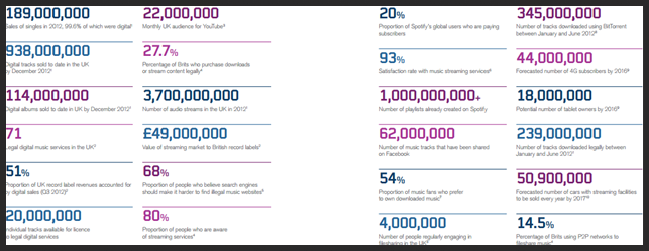 By Sophie Reyland
|
