Has Music Lost its Value in Modern Society due to its Vast Accessibility Over the Internet?
 The Value Of Music 'Value' is defined in the dictionary as firstly 'the regard that something is held to deserve; the importance, worth, or usefulness of something' and 'one's judgement of what is important in life'. Therefore, if the value of music as something to increase the enjoyment and meaning of life is its primary importance, then it is clear its value in society will never disappear. In a survey of 100 people, 81% said they would rather spend their time listening to music either live or recorded than any other pass-time. Furthermore, recent surveys show that over two million people every year in the UK go to music festivals 3, a number that seems to be constantly growing, and so the emotive value of music in modern society seems to be surviving and evolving in new directions. | Music In Modern SocietyEven though once described by Martin Luther King as, "the greatest treasure in the world"1, it is clear that music is starting to be thought of by the media and the public as something that has already seen its peak. Recent surveys show that the most popular radio stations are playing music from a different generation 2 and the recent rise in vinyl records would suggest that even younger people are playing older music, but does this mean music has lost its value in modern society, or just that it has taken on a new meaning? Pre and Post InternetThere have always been ways of accessing copies of music, whether taping a radio show or duplicating a record, even before the wave of internet piracy that began to cripple the industry in 1999. Yet, since researching into both the impact music has had on the public and its industry, I have discovered that the ways in which people enjoy music are constantly evolving and so are the ways in which the industry profits, but this is essential to the existence of the value of music in society. |
In terms of economic value it is the common belief that the internet is destroying the music industry and forcing record labels into manufacturing money-machines instead of supporting talented or innovative musicians. However, this graph from IFPI shows how even though in 2009, 95% of music downloads were illegal 4, that the music industry was still afloat in 2008 and stronger than in 1970's.
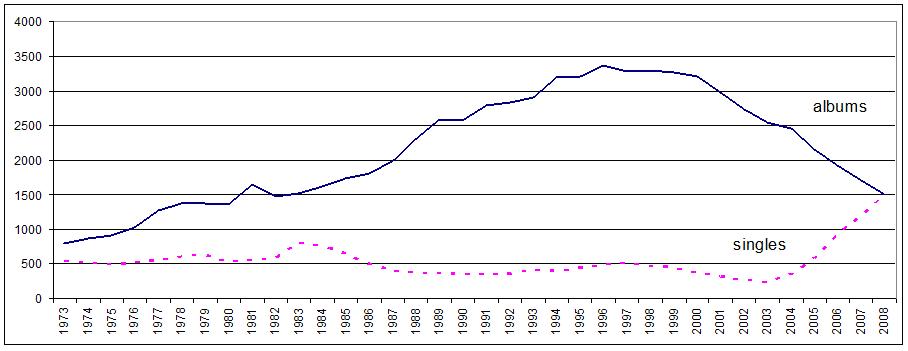
Therefore, it seems there have been other factors which have spurred the industry on and that the internet may have in fact saved music in modern society. I will discuss this in further detail on the next two pages comparing the industry before the advent of the internet and after.
